
Knowing how to start a fire without matches is one of those skills that sounds primitive until you actually need it. Matches get wet. Lighters run out of fuel. The moment you’re cold, wet, and stuck somewhere without a working ignition source is exactly when this knowledge earns its keep.
The good news: there are reliable methods that work in real conditions, not just ideal ones. Here’s an honest rundown of what works, what takes practice, and what you should carry as a backup.
How to Start a Fire Without Matches: Understand the Fire Triangle First
Before the methods, the principle: every fire needs fuel, heat, and oxygen. Most people trying to learn how to start a fire without matches fail because of poor fuel preparation, not poor technique. Dry, fine tinder is the foundation of every method below. Without it, even the best technique produces nothing but frustration.
Tinder is the finest, most combustible material: dry grass, birch bark, cattail fluff, shredded dry leaves, the inner bark of dead wood, dryer lint if you’ve brought it. It should be bone dry and break apart easily. Kindling comes next: pencil-thin sticks that catch from the tinder. Then fuel: the bigger wood that sustains the fire. Build this progression in your head before you start.
Ferro Rod (Firestarter) — The Most Reliable Modern Method
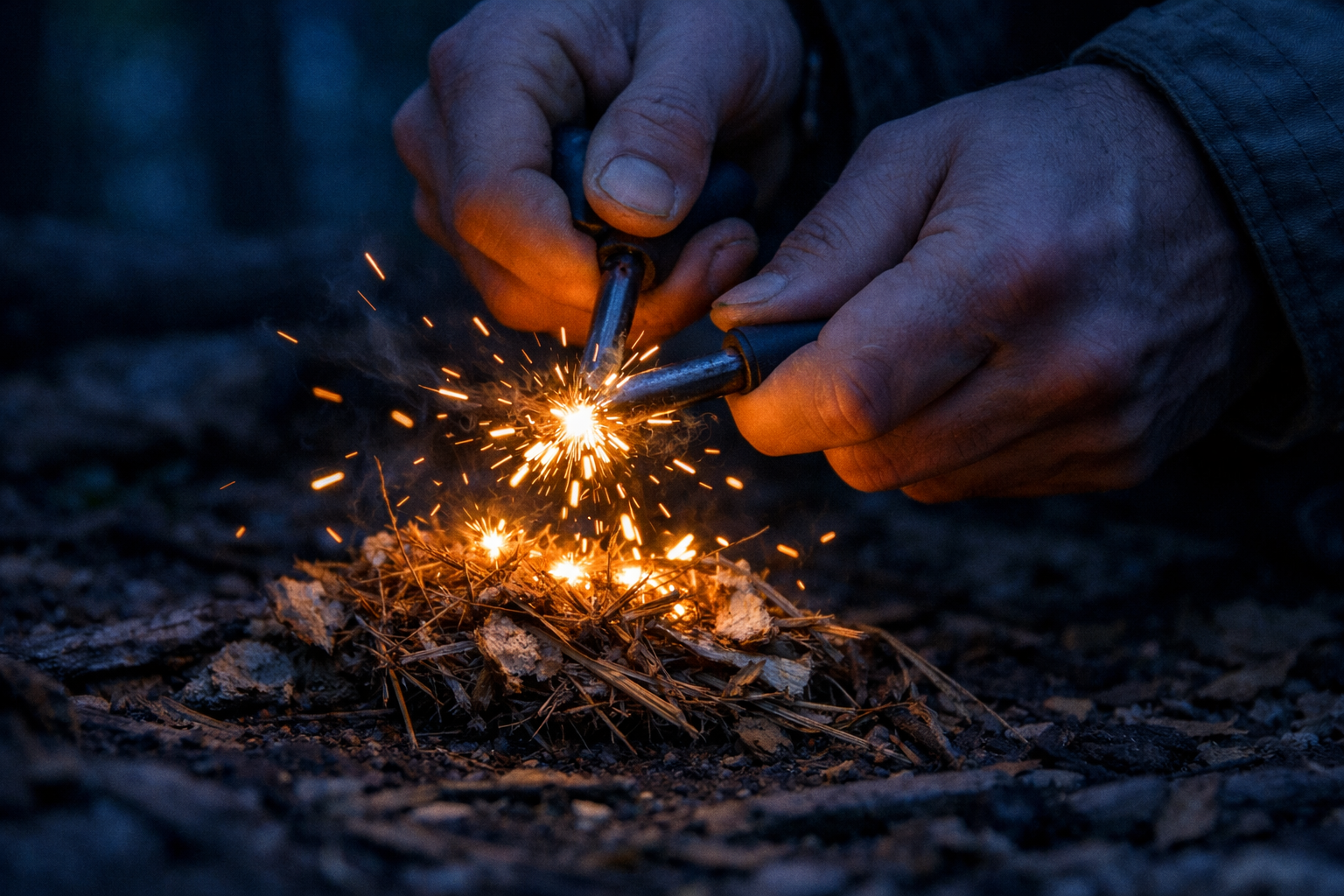
If you’re carrying anything as a backup ignition source, carry a ferro rod. It produces a shower of sparks at around 5,400°F, works wet, works cold, works at altitude, and a good one will produce thousands of strikes before wearing out. They cost between $5 and $20 and fit in a pocket.
The technique: hold the rod close to your tinder bundle, scrape the striker down the rod in one firm, controlled motion rather than moving the rod upward (which disturbs the tinder). Angle the sparks into the center of the tinder. When the tinder catches, gently blow until it develops into a flame, then transfer to your kindling structure.
A ferro rod isn’t truly starting a fire without matches in the traditional sense, but it’s the practical answer for anyone who wants reliable fire-starting capability as part of their kit. If you only add one thing, add this.
The Bow Drill — The Most Reliable Primitive Method
The bow drill is the friction fire method most likely to produce actual results for someone who has practiced it. It requires more preparation and effort than any spark-based method, but it works with entirely natural materials when done correctly.
The setup requires four components: a fireboard (flat piece of dry softwood such as cedar, willow, cottonwood, or basswood work well), a spindle (a straight dry stick of similar wood, about 12 inches long), a bow (a curved stick with cordage such as paracord, shoelace, or natural cordage), and a handhold (a harder wood or stone with a depression to hold the top of the spindle).
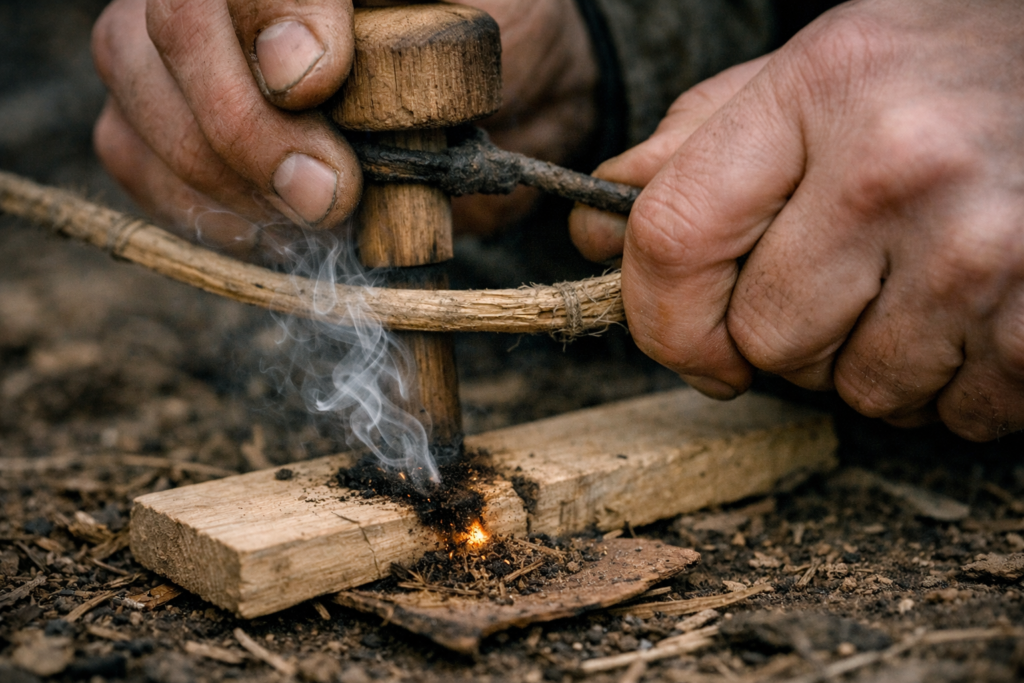
The technique: notch the fireboard, place a leaf under the notch to catch the coal, maintain steady downward pressure on the handhold, and use the bow to spin the spindle with long, even strokes. You’re generating friction heat, not sparks. When dark powder accumulates in the notch and begins to smoke on its own, you have an ember. Transfer it carefully to your tinder bundle and blow gently until it ignites.
The bow drill requires practice in dry conditions before attempting in a real survival situation. If you’ve never done it before, expect failure the first few times. The technique is learnable — but not in the rain, in the cold, when you’re already in trouble.
The Hand Drill — Harder, But Requires No Equipment
The hand drill is the same principle as the bow drill but uses the palms of both hands to spin the spindle rather than a bow. It requires less equipment but more skill and physical conditioning: the downward pressure while maintaining spin speed is genuinely demanding.
It works best in warm, dry conditions with the right wood combination. Cedar, willow, and mulberry are commonly used. The technique is harder to maintain than the bow drill and less recommended as a primary method for most people, but it works with zero prepared equipment, which matters in certain situations.
Flint and Steel — The Classic Method
True flint and steel fire-starting uses a piece of high-carbon steel struck against flint, chert, or quartz to produce sparks hot enough to ignite tinder fungus (a natural fungus that smolders from a single spark) or char cloth, cotton fabric charred until it catches the faintest spark. It was the primary fire-starting method for much of human history, and for good reason: it’s reliable when practiced.
It requires actual flint (or another hard, glassy rock like quartzite and chert work), a high-carbon steel striker (a modern hacksaw blade works), and a char cloth or tinder fungus to catch the spark. The spark temperature isn’t as high as a ferro rod, so the catching medium needs to be right.
Flint and steel is worth knowing as a backup, and as a skill it’s genuinely satisfying, but the ferro rod outperforms it in nearly every practical situation.
The Lens Method — Solar Ignition
A magnifying glass, reading glasses lens, or even a water-filled balloon or clear plastic bag can concentrate sunlight into a focused point hot enough to ignite tinder. This is the method that works the way it looks in movies: in full sun, with dry tinder, and with a lens that focuses a tight point.
The obvious limitation: it requires direct sunlight. It doesn’t work on overcast days, at dawn or dusk, or in any situation where the sun isn’t strong and direct. As a primary method it’s unreliable. As a supplemental tool when the conditions are right, it works well and requires no consumable supplies.
What to Actually Carry
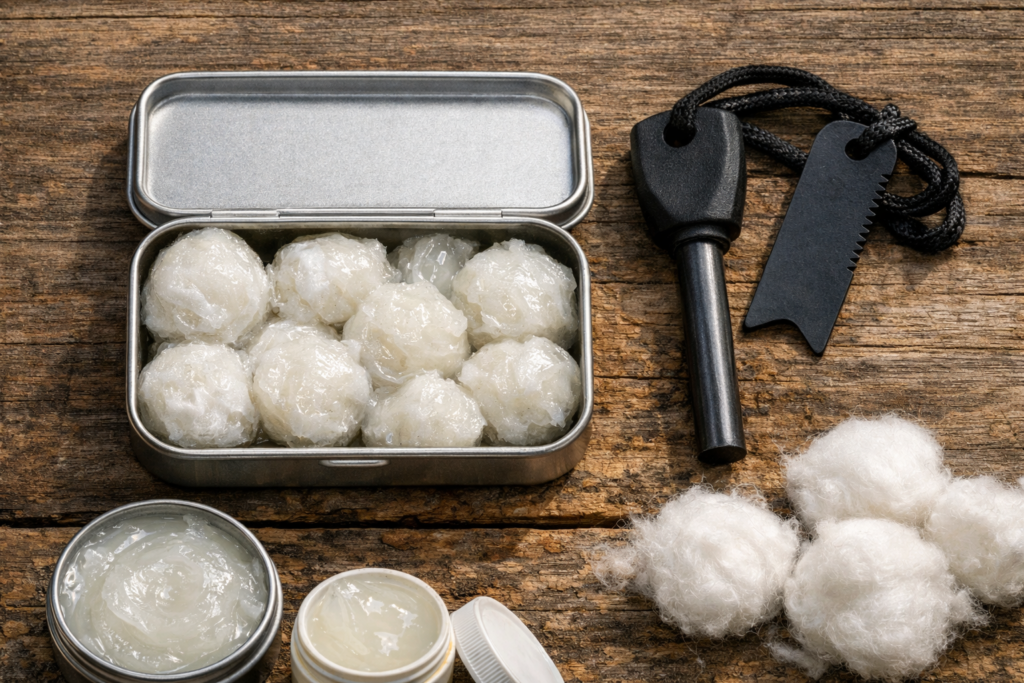
Knowing how to start a fire without matches is most useful when combined with the right gear. A ferro rod and a small supply of tinder material (cotton balls coated in petroleum jelly work extremely well and cost almost nothing to prepare) fits in any pocket and covers 99% of real-world fire-starting situations.
Beyond that: know at least one primitive method well enough to use it under pressure. The bow drill is the most practical to learn. Practice it at home, in good conditions, until you can reliably produce a coal before you rely on it anywhere else. Fire and water are the two skills that tend to matter together. Once you’ve got fire covered, knowing how to purify water without electricity is the natural next skill to pick up.
A fire you can start in the conditions you’re actually in is worth more than ten methods you’ve only read about. Pick one primitive technique, practice it until it works, and carry a ferro rod as your real-world backup.
Q: What is the easiest way to start a fire without matches?
A ferro rod is the most reliable and practical method for real-world use: it works wet, works cold, and produces sparks hot enough to ignite prepared tinder easily. For a purely primitive method, the bow drill is the most learnable and consistently effective when practiced with the right dry wood combination.
Q: What wood works best for a bow drill fire?
Softwoods with low moisture content work best: cedar, willow, cottonwood, and basswood are commonly recommended. The fireboard and spindle should be the same or similar wood. The single most important factor is dryness: even the best technique fails with damp wood.
Q: Can you start a fire with wet wood?
Wet wood is one of the hardest fire-starting challenges. A ferro rod helps because its spark temperature is very high, but tinder still needs to be dry to catch. In wet conditions, look for dry material under bark, inside split wood, or in sheltered spots. Carrying pre-prepared tinder like cotton balls in petroleum jelly, eliminates this problem entirely.