
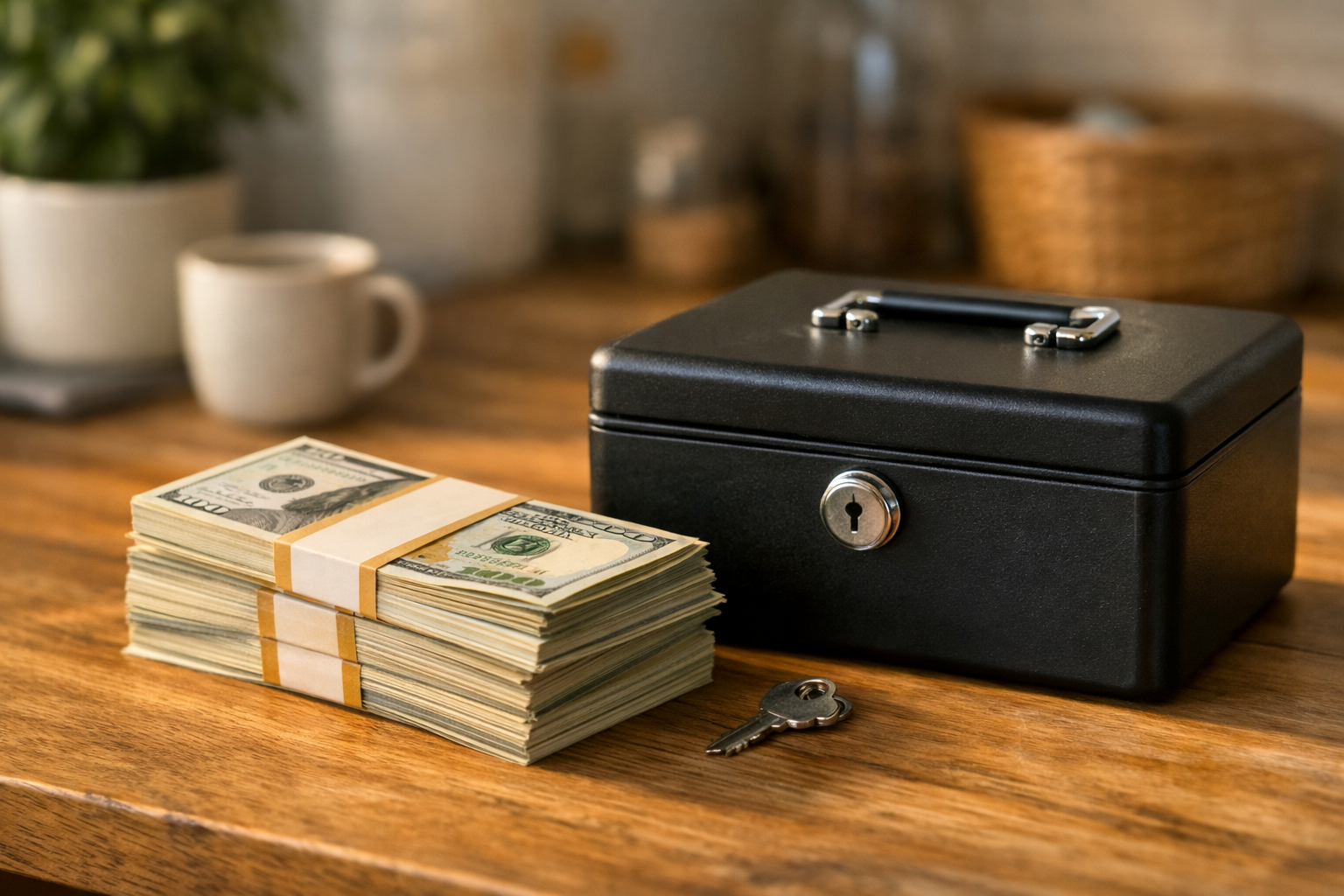
How much cash should I keep at home is one of those questions people think about after a power outage — when the card reader is down, the ATM has a line around the block, and the $23 in their wallet isn’t going to cut it. The answer is more practical than dramatic, and it doesn’t require a safe behind a painting.
Here’s a straightforward way to think about what cash actually gets used for when things go sideways, and how to store it without overthinking it.
Why Cash Still Matters
Most people operate almost entirely on cards and digital payments now. That works fine until it doesn’t. Power outages knock out card terminals. Bank system outages (which happen more often than the news covers) freeze digital transactions. Regional disasters can disrupt ATM networks for days at a time.
Cash works when nothing else does. It requires no infrastructure, no network connection, no functioning bank. A week after a hurricane, a gas station running on a generator will take cash. It may not take anything else. This isn’t about distrust of banks or a prediction that the financial system is about to collapse. It’s the same logic as keeping a paper map in the car. The digital version is better 99% of the time. The analog version works when the digital one doesn’t.
You hope you never need it. That’s not a reason to skip it.
How Much Cash Should I Keep at Home? The Practical Ranges.
There’s no universal right answer, but there are useful benchmarks based on what these situations actually cost:
- Minimum — $200 to $300: Covers small, short-term disruptions. A day or two without card access. Basic groceries, gas, a meal. This is the floor — almost everyone should have at least this much accessible at home.
- Moderate — $500 to $1,000: Covers a week of disruption for a single person or a couple of days for a family. Enough for fuel, food, medication, and basic needs without stress.
- Prepared — $1,000 to $2,000: A family reserve that covers 1-2 weeks of essential expenses without relying on any electronic payment system. This is the range most preparedness-minded households aim for.
The right number for you depends on your monthly expenses, household size, and how long you want to be prepared to go without normal banking. Figuring out how much cash should I keep at home really comes down to one rough target: one week of your essential spending (food, fuel, medication) in cash, accessible at home.
What Denominations to Keep
Denominations trip people up more than they expect. A $500 stack of $100 bills sounds useful until you’re trying to pay $12 for gas and the attendant can’t make change. When things are disrupted, businesses often struggle with change, and some won’t accept large bills at all.
A practical breakdown for a $500-$1,000 reserve:
- $20s — the majority of your reserve. Widely accepted, easy to make change for, the workhorse of everyday transactions.
- $10s and $5s — useful for smaller purchases and anywhere exact change counts.
- $1s — a small stack for vending machines, tips, and very small transactions.
Avoid keeping large bills ($50s and $100s) as the bulk of your reserve. They’re harder to use when things go wrong, and some vendors (particularly smaller ones operating on generator power during an emergency) won’t accept them.
Where to Store It
Home cash storage comes down to three priorities: accessible enough to use quickly, secure enough that it isn’t the first thing a burglar grabs, and not so hidden that you forget where it is.
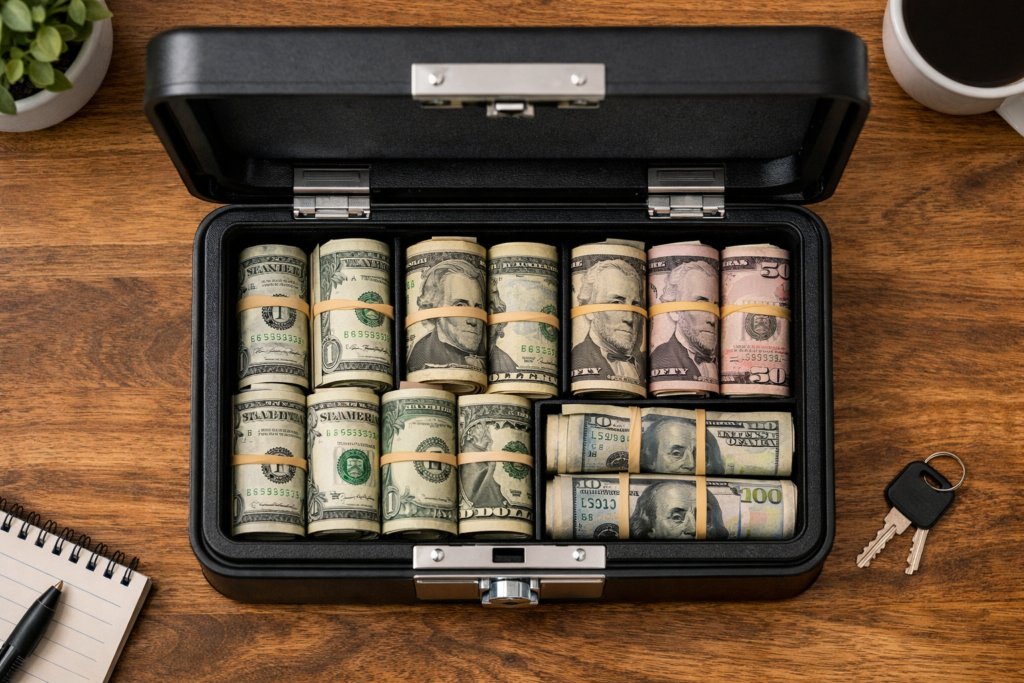
- Fireproof lockbox: A small fireproof lockbox is the most practical solution for most households. They’re inexpensive, protect against fire and water damage, and aren’t easy to pocket quickly. Bolt it to a shelf or floor if you want a higher level of security.
- Skip the obvious hiding spots: Avoid the obvious spots: the sock drawer, under the mattress, inside a cookie jar. These are the first places checked in a burglary and the last places that deserve your trust.
- Split it up: Splitting your reserve between two locations in the house is a reasonable precaution. If one spot is discovered or inaccessible, you still have the other.
Tell someone you trust where it is. A reserve that only you know about stops being useful if you’re the one who’s incapacitated in an emergency.
Should You Worry About Cash Losing Value to Inflation?
Inflation does erode cash over time. That’s real and worth acknowledging. A $1,000 home reserve held for five years will buy slightly less than it does today. For a preparedness reserve, not an investment, this is an acceptable trade-off. You’re not trying to grow this money. You’re trying to have it available when digital systems fail — which is the same problem you’d run into with what happens to your money if a bank fails: the money’s still there, you just can’t get to it.
That said, if you find yourself holding significantly more than two weeks of expenses in cash at home, the excess probably belongs in a high-yield savings account where it earns something rather than sitting still. The reserve has a purpose. Beyond that purpose, cash is just idle money losing a slow race against inflation.
What About Keeping Cash in the Car?
A small separate amount ($50 to $100) kept in the car is worth considering independently of your home reserve. Roadside situations, drive-throughs during a power outage, a parking meter that doesn’t take cards: these happen regularly and a small car stash handles them without touching your home reserve.
Keep it somewhere that isn’t the center console or glove compartment, both of which are checked in most car break-ins. A slim envelope tucked elsewhere in the vehicle is enough.
Replenishing and Maintaining the Reserve
Cash reserves get used. After any event where you dip into your home supply, replenish it on your next trip to the bank or ATM. Treat it like you’d treat any other household supply: rotating and restocking as part of the routine, not an afterthought.
Knowing how much cash should I keep at home is one thing. Actually having it there when it matters is another. Set a number, get there incrementally if needed, and check it occasionally. The preparation happens once. The peace of mind is ongoing, and it costs exactly what you put in the box.
How much emergency cash should I have at home?
A practical minimum is $200-$300 for short disruptions. Most preparedness-minded households aim for $500-$1,000, which covers a week of essential expenses — food, fuel, medication — without any electronic payment access.
What bills should I keep in my emergency cash stash?
Keep the majority in $20 bills, which are the most widely accepted and easiest to make change for. Add some $10s, $5s, and a small stack of $1s. Avoid making large bills like $50s and $100s the bulk of your reserve — they’re harder to use when the power’s out or systems are down, since businesses may not have change.
Is it safe to keep cash at home?
Yes, with basic precautions. A small fireproof lockbox is the most practical option — it protects against fire and isn’t easily pocketed. Avoid obvious hiding spots and consider splitting your reserve between two locations. Tell someone you trust where it is.