
Knowing how to make a family emergency plan is different from actually having one. Most families are somewhere in the middle: they’ve thought about it, discussed it vaguely, and assume that when something happens everyone will figure it out. That assumption holds up fine until it doesn’t.
A family emergency plan doesn’t need to be a binder with laminated tabs. It needs to answer four questions everyone in the household can answer without looking anything up: Where do we go? How do we reach each other? What do we take? Who do we contact outside the area?
How to Make a Family Emergency Plan: The Four Questions It Has to Answer
Learning how to make a family emergency plan starts with treating it as a decision tree that removes the need to think clearly under pressure. In an emergency, people under stress make worse decisions. A plan made in advance eliminates decisions that don’t need to be made in the moment.
The four questions: Where do we meet if we can’t be reached by phone? How do we communicate when cell networks are down? Where do we go if we have to leave home? Who outside our immediate area is our check-in contact? Write the answers down and make sure everyone knows them.
Meeting Points
Set two meeting points: one near the house for situations where you can’t re-enter the home, and one further away for situations where the neighborhood is inaccessible.
The near meeting point handles fires, gas leaks, and fast evacuations. The far meeting point handles broader emergencies requiring overnight absence. Make sure children know both and can give the addresses to another adult.
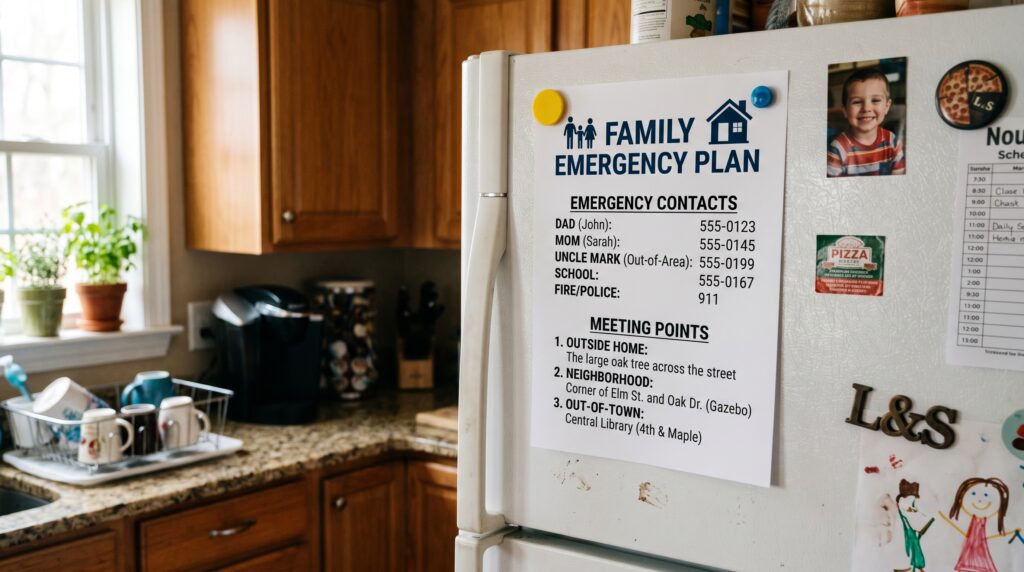
The near meeting point is the one most families skip because it feels obvious. It isn’t obvious to a child, and it isn’t obvious to a family member arriving home to an emergency already in progress.
Communication When Phones Are Down
Cell networks fail in exactly the situations where you most need them. Text messages often go through when calls don’t — they use less bandwidth and queue until a connection is available. Teach everyone in the household to try texting first.
Designate an out-of-area contact who becomes the communication hub. Each family member checks in with this person, who relays information to others. Local networks are more likely to fail than national ones.
Know what your children’s school does in a lockdown or evacuation, and don’t put pickup plans in place that conflict with their protocols.
Write your out-of-area contact’s number on paper and make sure every household member has it — including children old enough to use a phone independently. If that contact isn’t someone everyone knows personally, make sure they understand their role before an emergency happens. A communication hub that doesn’t know they’re the hub isn’t much use.
Evacuation Routes
Map two routes out of your neighborhood — the main route and a backup that doesn’t share the same road. In a regional emergency, the most obvious exit is often the most congested. A backup route planned in advance can be the difference between two hours and twenty minutes.
If you live in an area with known hazards, know the official evacuation routes and designated shelters. A paper map belongs in your car and in your emergency kit.
If your household has two vehicles, decide now which route each takes if you’re leaving separately, and where you reunite if you can’t reach each other en route. A gas tank below a quarter isn’t an emergency problem, until it suddenly is. Keeping it above half during elevated-risk periods (hurricane season, wildfire season, winter storms) costs almost nothing and removes one variable from a situation that may already have too many. The same forward-thinking applies at home: making your home more secure before you ever need to evacuate means there’s less to worry about on the way out.
What to Grab and Where It Is
Your plan should include a clear answer to “what do we take if we have 10 minutes.” For most households: go-bags already packed and in a known location, important documents accessible quickly, medications, and phone chargers. It also helps to already know how much cash you should keep at home for situations where cards and ATMs aren’t an option, and to have settled how much water to store per person so that part of the plan isn’t a last-minute guess. If you’re evacuating by car, what to keep in your car for emergencies should already be packed and waiting, not assembled on the way out the door.
“I’ll grab what I need” is not a plan. Under stress and time pressure, people forget obvious things and grab irrelevant ones. A pre-packed bag removes that variable.
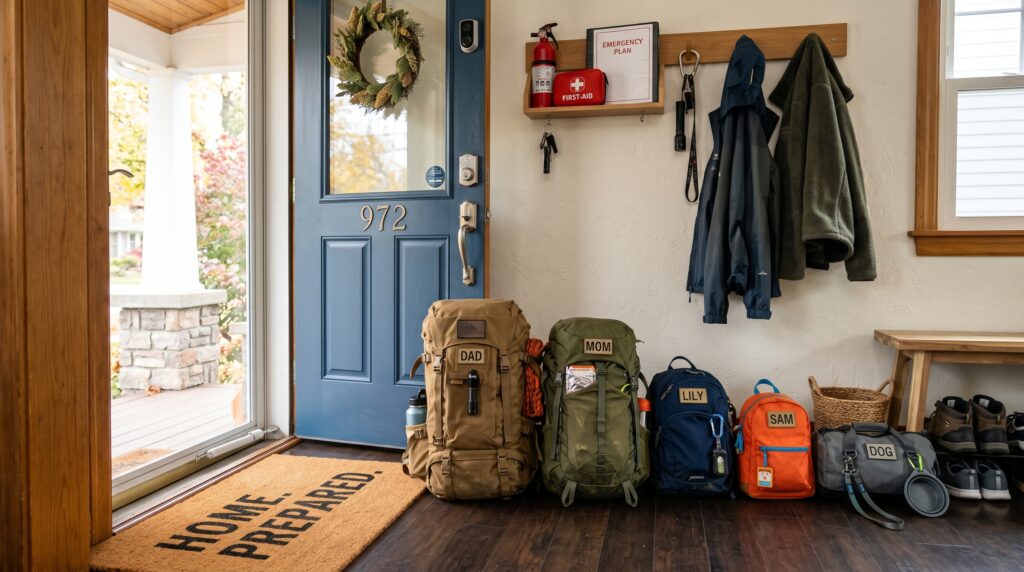
Most families overestimate how much time they’ll have and underestimate how much stress they’ll be under. Planning for 10 minutes means you’re covered if you have 10, and very well covered if you have 30.
Special Needs and the Gaps Most Plans Miss
Pets require carriers, food, water, vaccination records, and a destination — emergency shelters often don’t accept animals. Children need comfort items, medications, and instructions they can follow without prompting. Older adults or anyone with mobility limitations may need evacuation assistance arranged in advance.
Run through the plan with everyone in the household. A plan that only the adults know is only half a plan.
Practicing the Plan
A plan reviewed once and filed away is better than nothing. A plan that’s been walked through is significantly better than that. Once a year — same time as your review — do a brief run-through with the household. Not a full drill, just a conversation: where do we meet, who do we call, where are the bags. It takes ten minutes and cements the information in a way that reading it doesn’t.
For households with children, the walk-through also lets you adjust for how they’ve grown. What a seven-year-old needs to hear is different from what a twelve-year-old needs to hear. The plan doesn’t change, but the way you explain it does.
The goal isn’t to make children anxious about emergencies — it’s to make them confident. A child who knows exactly what to do and where to go handles a frightening situation better than one who doesn’t. Same goes for every adult in the house.
Keep It Current
How to make a family emergency plan is a one-time task. Keeping it current is a light recurring one — phone numbers change, children grow, households move. A brief annual review paired with your smoke detector check keeps everything accurate.
Write it down and post the key information somewhere accessible — the refrigerator, a family bulletin board, the inside of a cabinet door. The plan that exists only in someone’s head stops being a plan if that person is the one who needs help.
What should a family emergency plan include?
At minimum: two meeting points, a communication strategy for when cell networks fail, an out-of-area contact, two evacuation routes, a list of what to grab and where it is, and provisions for pets and household members with special needs. Every adult and older child should know the four core questions without looking anything up.
How do families communicate during an emergency when cell service is down?
Text messages often go through when calls don’t — try texting first. Designate an out-of-area contact that everyone checks in with, since local networks fail before national ones. Know your household members’ daily locations and their institutions’ emergency procedures.
How often should you update your family emergency plan?
A brief annual review is sufficient for most households — update phone numbers, adjust for changes in household composition, and confirm everyone still knows the meeting points and out-of-area contact. Pair it with your annual smoke detector check.