Knowing how to purify water without electricity is the kind of skill you hope stays theoretical — right up until a boil-water notice hits after a storm, the well pump won’t run without power, or a hike goes an hour longer than planned. The methods that hold up in practice haven’t changed in decades, and none of them need an outlet. This isn’t a list of every trick mentioned around a campfire. It’s a ranked look at what kills what’s in the water, what falls short, and where each method breaks down under real conditions.
Boiling: The Method With the Fewest Asterisks
Boiling is the closest thing to a universal answer here. A rolling boil — water at a full, vigorous boil, not just simmering — for one minute kills bacteria, viruses, and protozoa, including Giardia and Cryptosporidium, the two organisms chemical treatments struggle with most. Above 6,500 feet, extend that to three minutes, since water boils at a lower temperature the higher you climb. There’s no dosage to calculate, no contact time to sit through, no shelf life to track. If you can get water to a hard boil, the biological problem is solved.
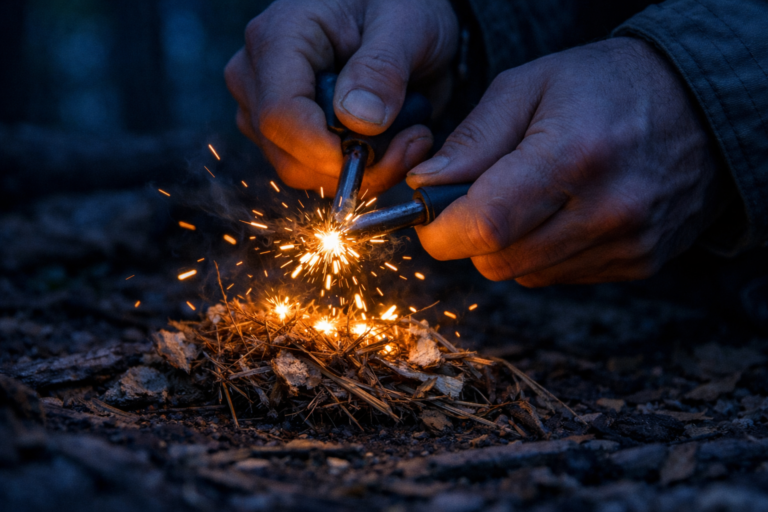
The catch is that boiling only solves the biological problem. It won’t remove sediment, heavy metals, or chemical contamination, and it depends entirely on having a reliable heat source. If your backup plan for heat depends on a lighter that fails in wind or rain, get comfortable with how to start a fire without matches before you need it — not during the outage itself.
Chemical Treatment: Tablets, Drops, and Household Bleach
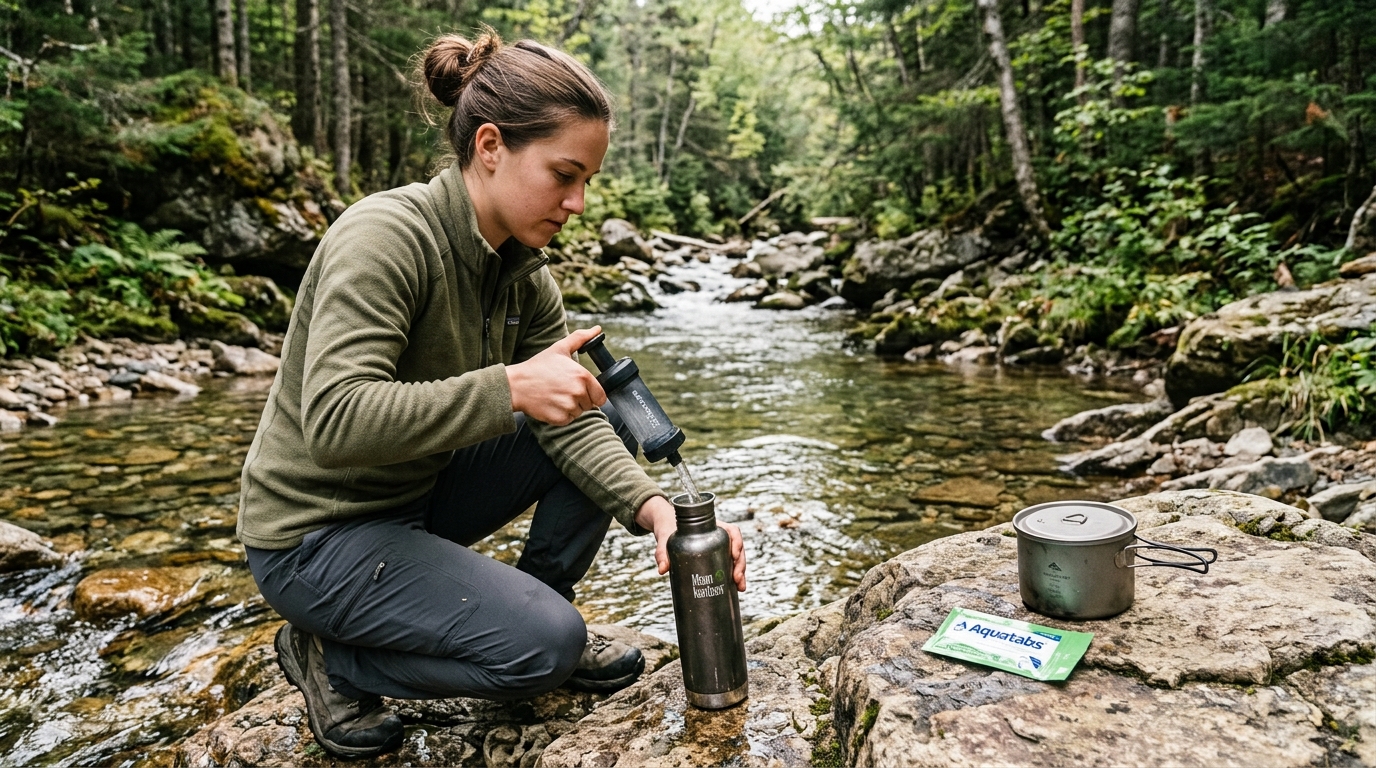
When boiling isn’t practical (no fuel, no time, or water that needs treating on the move), chemical disinfection is the next line of defense. Iodine and plain unscented household bleach both handle bacteria and viruses well: five drops of 2% iodine tincture per quart of clear water, doubled for cloudy water, stirred and left to sit for thirty minutes. Chlorine dioxide tablets work on a similar principle but go further; they’re the only chemical option genuinely effective against Cryptosporidium, provided you give them the full four-hour contact time in cold or cloudy water. That wait is the tradeoff. Cutting it short defeats the point of using the tablet at all.
Iodine and bleach share the same weak spot: neither reliably kills Cryptosporidium at concentrations safe to drink, and iodine isn’t something to rely on for more than a couple of weeks straight, especially for anyone with a thyroid condition. None of that makes chemical treatment a bad option. It just means treating it as a backup to filtration and boiling, not a first choice for water you already suspect is contaminated.
Filtration: What It Removes, and What Slips Through
A portable filter rated at 0.1 microns or smaller pulls out protozoa and bacteria mechanically — no chemicals, no waiting, no aftertaste. That’s why filtering first and disinfecting second is the standard field approach to how to purify water without electricity: filtration handles Cryptosporidium and Giardia, the two protozoa that give chemical treatment the most trouble, while a follow-up chemical dose or a few minutes of boiling mops up anything small enough to slip through, mainly viruses.
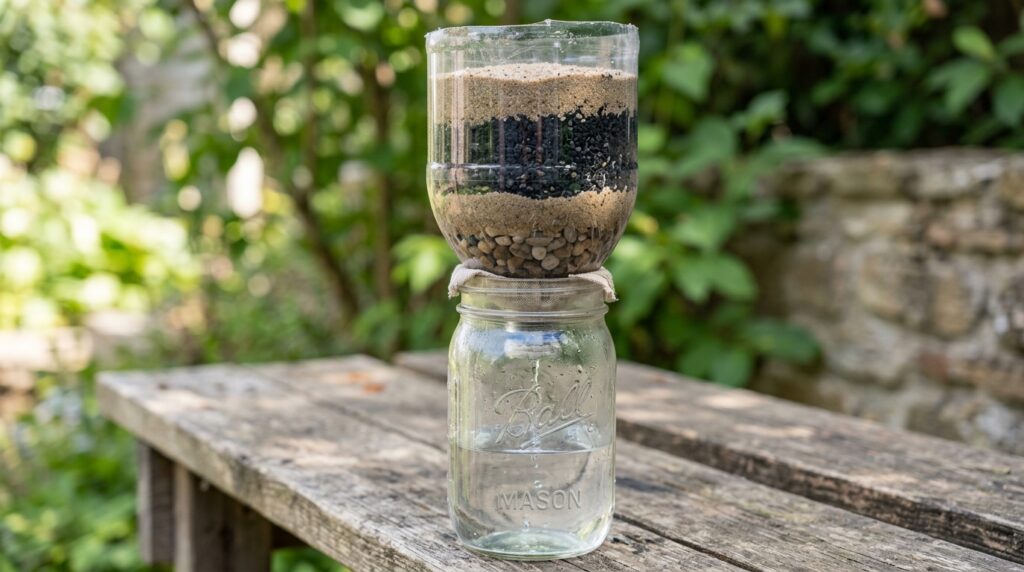
A store-bought filter is the dependable version of this. A homemade sand-and-charcoal filter (gravel on the bottom, then sand, then activated charcoal, built into a bucket or a cut-open two-liter bottle) is the improvised version, and to be blunt about what it does: it clears out sediment and improves taste and smell. It doesn’t reliably remove pathogens on its own. Ask anyone who’s built one after a storm knocked out the tap water how tempting it is to drink the clear result straight from the filter, and how that clear-looking water is exactly the water that still needs a follow-up boil or chemical dose before anyone drinks it.
It holds true for rainwater too. If you’re setting up a system for how to collect rainwater at home, catching it and making it safe to drink are two separate steps — no matter how clean it looks coming off the roof.
Solar Disinfection and Distillation
Sunlight does real work here too, just slowly. It’s worth separating the two methods in this section: one is a biological-safety fallback, the other solves a problem boiling and filtering can’t touch at all. SODIS (solar water disinfection) uses UV radiation to damage pathogens: fill a clear plastic bottle with relatively clear water, lay it on a reflective surface like a metal roof or foil, and leave it in direct sun for six hours, or two full days if the sky is overcast. It’s nearly free and needs nothing but a bottle and patience, which makes it a reasonable backup once fuel and tablets have both run out. It does need genuinely clear water to let UV penetrate, though, and it does nothing for chemical contamination.
Distillation solves a different problem. Boiling water and capturing the steam as it condenses leaves behind salts, heavy metals, and most chemical contaminants, which makes it the only method here that handles non-biological hazards. It’s slow, it needs a heat source and some improvised plumbing, and it’s overkill for a stream that just needs its bacteria dealt with — but for water contaminated with something boiling alone can’t touch, it’s the method that earns the extra effort.
Combining Methods for Water You Don’t Trust
None of these methods are mutually exclusive, and questionable-looking water is exactly when stacking them pays off. Filter first to pull out debris and the toughest protozoa, then boil or add a chemical treatment to finish the job on anything left behind. It’s a five-minute filter pass plus a thirty-second boil, not two separate ordeals, and it covers more ground than any single method run alone.
Clear-looking water from a trusted source doesn’t need the full stack every time. This is where reading the source counts more than following a fixed checklist: a covered rain barrel you fill and use quickly is a different risk than a stagnant pond after a flood, and treating them identically either wastes tablets on water that didn’t need them or under-treats water that did.
What Doesn’t Work
A few methods get repeated often enough to sound credible, and none of them hold up. Freezing water doesn’t purify it — most pathogens survive freezing just fine and go right back to work once the ice melts. Letting cloudy water “settle” overnight clears out visible sediment but does nothing to the bacteria and viruses suspended in it. And alcohol, in the concentrations found in a flask or hand sanitizer, isn’t strong enough or applied long enough to disinfect drinking water. That’s a rumor that refuses to die, and it’s one that deserves to be retired for good.
There’s no single best method for how to purify water without electricity. There’s a best method for the water in front of you — and now you have the tools to tell the difference. Pair this with knowing how much water to store per person, and purification stops being a theoretical skill. It becomes part of an actual plan: enough stored to get through the first few days, and a reliable way to make more once that runs out.
Does boiling water remove all contaminants?
Boiling kills bacteria, viruses, and protozoa like Giardia and Cryptosporidium, but it doesn’t remove sediment, heavy metals, or chemical contamination. For water with those additional risks, pair boiling with filtration or distillation.
How long should you boil water to purify it?
A rolling boil — water at a full, vigorous boil, not just a simmer — for one minute is enough at most elevations. Above 6,500 feet, extend that to three minutes, since water boils at a lower temperature as altitude increases.
Is bleach a reliable long-term option for purifying water?
Household bleach works against bacteria and viruses at the right dose, but it doesn’t reliably kill Cryptosporidium and it degrades in storage over time. Rotate stored bleach yearly and treat it as a backup to filtration or boiling, not a standalone solution.